
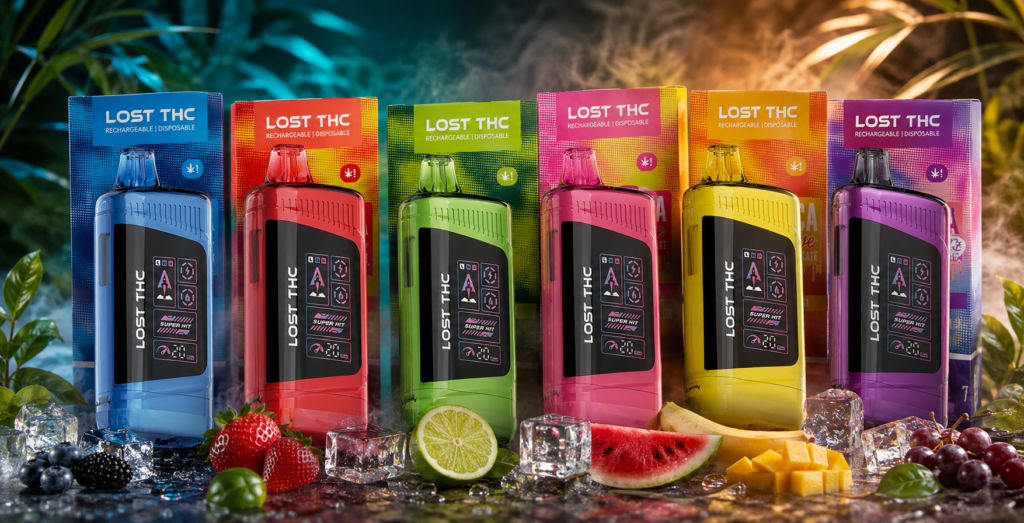
The disposable vape market has changed significantly as manufacturers continue experimenting with concentrated cannabinoid blends, terpene-rich extracts, and more advanced hardware. Among the newer products attracting attention is the Lost THC THCa Live Concentrate V3 Disposable Vape 7.5g, a high-capacity disposable designed around a blend of THCa, Delta-9 THC, Delta-6 THC, and other cannabinoids.
Unlike a conventional single-cannabinoid vape, the V3 is marketed as a multi-cannabinoid product that combines live concentrate with strain-specific terpenes. Retail product listings describe the device as containing 7.5 grams of concentrate and featuring rechargeable hardware, a digital display, multiple voltage settings, and a preheat function. Exact formulation and hardware specifications can vary by edition or seller, so buyers should always check the product packaging and current certificate of analysis (COA) before relying on a particular specification.
This guide takes a closer look at what the Lost THC V3 is, how its cannabinoid blend differs from traditional THC products, what live concentrate means, the features associated with the device, available strain profiles, testing considerations, and the important questions consumers should ask before purchasing a hemp-derived cannabinoid product.
What Is the Lost THC V3 Disposable Vape?
The Lost THC V3 Disposable Vape is a high-capacity disposable cannabinoid device marketed with a 7.5-gram concentrate capacity. Product listings describe the V3 formulation as a combination of THCa live concentrate with Delta-9 THC, Delta-6 THC, THCP, and strain-specific terpenes.
The product is positioned differently from a basic disposable containing only one cannabinoid. Instead, its appeal centers on a broader cannabinoid profile and a concentrate-focused formulation.
Retail descriptions also associate the V3 with features such as a rechargeable battery, USB-C charging, a digital display, preheat functionality, and adjustable voltage settings. Some listings specify a 650mAh battery and three voltage levels, while other V3 listings describe different hardware configurations. That variation is important because product editions and manufacturing runs can change over time.
For that reason, the best way to evaluate a specific device is to compare its packaging, batch information, and laboratory report rather than relying exclusively on a retailer’s general product description.
Why the Lost THC V3 Has Attracted Attention?
Large-format disposables have become increasingly common in the hemp-derived cannabinoid market. Instead of carrying a small cartridge and separate battery, an all-in-one disposable combines the extract reservoir, heating system, battery, and mouthpiece into a single device.
The V3 takes that concept further by combining several cannabinoids in one formulation.
The product is particularly notable for its reported:
- 7.5-gram concentrate capacity
- THCa live concentrate
- Delta-9 THC component
- Delta-6 THC component
- THCP component
- Strain-specific terpene profiles
- Rechargeable battery
- Integrated display on certain versions
- Variable voltage functionality on listed versions
- Preheat functionality
- Compact box-style construction
These specifications come from current retail and product listings and should be verified against the exact product version being considered.
The combination of a large reservoir and multiple cannabinoids is what separates this product concept from many conventional vape cartridges.
Understanding THCa Live Concentrate
One of the most important terms in the product name is THCa Live Concentrate.
THCa, or tetrahydrocannabinolic acid, is the acidic precursor to THC that naturally occurs in raw cannabis. THCa itself is not considered intoxicating in the same way as delta-9 THC. When exposed to sufficient heat, however, THCa can undergo decarboxylation and form THC.
That chemistry explains why heating a THCa-containing vape formulation is fundamentally different from simply consuming raw cannabis material.
The word “live” generally refers to extraction approaches that begin with fresh cannabis material that is preserved soon after harvesting, often through freezing. The objective is to retain more of the plant’s volatile compounds, particularly terpenes, compared with some traditional extraction processes.
A live concentrate therefore focuses heavily on preserving the aromatic and flavorful characteristics associated with the source plant.
However, consumers should distinguish between a marketing description and independently verified composition. A product labeled “live concentrate” should ideally have laboratory documentation showing cannabinoid concentrations and contaminant screening.
What Makes the V3 Different From a Standard Disposable?
A conventional disposable might contain a relatively simple formulation and a small reservoir. The Lost THC V3 is marketed around a substantially larger capacity and a more complicated cannabinoid profile.
Instead of focusing exclusively on one compound, the formulation reportedly combines THCa, Delta-9 THC, Delta-6 THC, and THCP alongside terpene-rich concentrate.
The hardware also plays an important role.
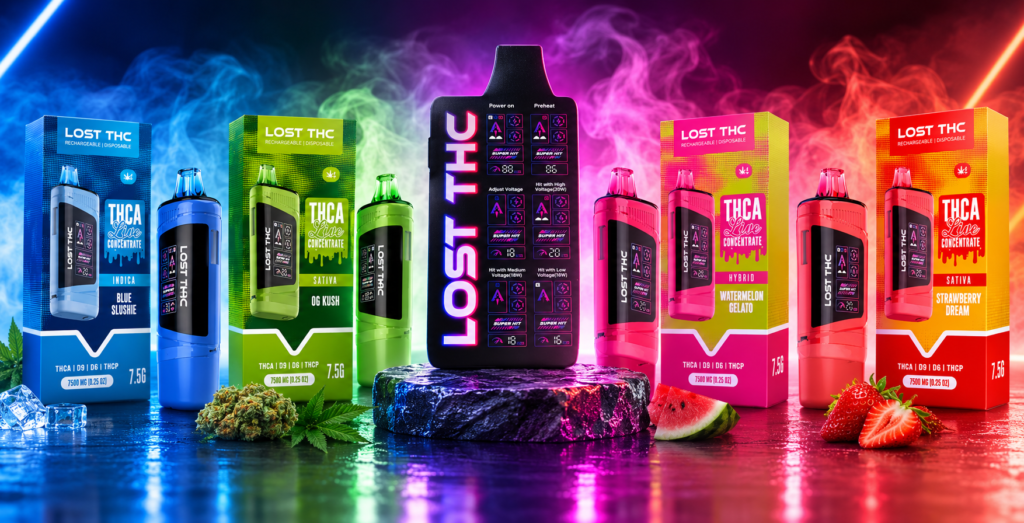
According to several listings, the V3 design includes a rechargeable battery, a digital or “mega” display, preheat functionality, and adjustable voltage settings. Some descriptions also identify ceramic heating technology, while others describe dual-mesh hardware, showing that specifications may differ across versions or listings.
This is why checking the exact package is important when comparing different Lost THC V3 devices.
The Cannabinoid Profile Explained
The appeal of the V3 largely comes from its multi-cannabinoid formulation. Understanding each compound provides useful context for evaluating the product.
THCa is the acidic cannabinoid naturally found in raw cannabis. It becomes THC when exposed to heat through decarboxylation.
Delta-9 THC is the best-known intoxicating cannabinoid associated with traditional cannabis. Its presence is particularly important when evaluating hemp-derived products because regulatory requirements may depend on the amount and source of delta-9 THC.
Delta-6 THC is a less familiar cannabinoid name that appears in some contemporary hemp-derived formulations. Because research on newer cannabinoids can be considerably less developed than research on delta-9 THC, consumers should be cautious about assuming that products containing Delta-6 THC have identical effects or safety profiles.
THC is another cannabinoid that has attracted attention because of its strong interaction with the body’s cannabinoid receptors in laboratory research. Human evidence remains much more limited than for established cannabinoids.
The key takeaway is simple: a multi-cannabinoid product should not automatically be considered better simply because it contains more compounds. The actual concentrations, purity, testing, and manufacturing quality matter.
How Delta-9 THC Fits Into the Formula
Delta 9 THC is the primary intoxicating cannabinoid most people associate with cannabis.
In hemp-derived products, delta-9 THC content is especially important because federal and state regulations can distinguish products based on THC concentration, source, and other factors. Regulations also vary considerably by jurisdiction.
Some Lost THC V3 listings describe the formulation as containing THCa alongside Delta-9 THC and other cannabinoids, while one product listing states that the product contains less than 0.3% Delta-9 THC.
Consumers should not assume that this statement applies to every V3 edition. Laboratory results for the specific batch are a much stronger source of information.
A current COA can provide a cannabinoid breakdown and help establish whether the product’s stated composition matches the tested sample.
What Is Delta-6 THC?
Delta 6 THC is one of the less familiar cannabinoids appearing in modern hemp-derived products.
Compared with delta-9 THC, it has received substantially less scientific attention, particularly in human clinical research. This makes it important to avoid exaggerated claims about its effects.
Product descriptions sometimes associate Delta-6 THC with a broader or more balanced cannabinoid experience, but marketing language should not be confused with established medical evidence.
For consumers, the most useful approach is to look at the laboratory report and determine exactly how much Delta-6 THC is present rather than relying on generalized claims.
The same principle applies to THC and other emerging cannabinoids.
Live Concentrate and Terpenes
Terpenes are aromatic compounds found throughout the cannabis plant and many other plants. They contribute to the characteristic smell and flavor of different cannabis varieties.
Live concentrate products are often marketed toward consumers who value these aromatic characteristics.
A strain marketed as OG Kush, for example, may have a different terpene profile from a fruit-forward variety such as Blue Slushie or Watermelon Gelato.
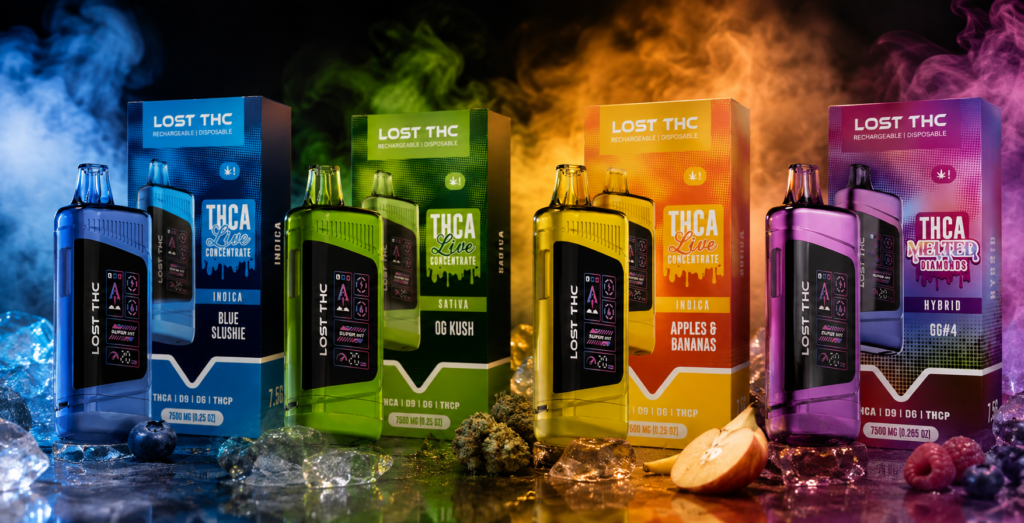
Retail listings for the Lost THC V3 have included strain choices such as OG Kush, Blue Slushie, Apples & Bananas, Watermelon Gelato, and Strawberry Dream, although the available selection can differ by seller.
Rather than assuming a strain name guarantees a particular effect, it is more useful to consider the product’s actual cannabinoid and terpene information when available.
Lost THC V3 Strain Options
One of the more interesting aspects of the V3 lineup is its range of strain-inspired profiles.
Commonly listed options include:
OG Kush: Often associated with earthy, herbal, and citrus-like cannabis aromas.
Blue Slushie: Generally positioned as a sweet, fruity profile.
Apples & Bananas: A fruit-forward profile combining sweet and tropical-style notes.
Watermelon Gelato: Typically marketed around sweet watermelon and creamy dessert-like flavors.
Strawberry Dream: A berry-oriented profile intended for consumers who prefer fruit-forward aromas.
These strain names appear across multiple retail listings, but availability is not universal.
The actual flavor profile can also vary depending on the terpene formulation, batch, storage conditions, and manufacturing process.
Hardware Features of the V3
The hardware is another major part of the Lost THC V3 concept.
Unlike a traditional disposable that may be completely fixed, several V3 listings describe a rechargeable system with additional controls.
Reported features include:
- Integrated rechargeable battery
- USB-C charging
- Digital display
- Battery indicator
- Oil-level indicator
- Voltage information
- Preheat function
- Multiple voltage settings
- Button activation
- Ergonomic mouthpiece
One retailer specifically lists a 650mAh battery and three voltage settings of 2.8V, 3.2V, and 3.7V.
However, because different versions and listings describe hardware differently, these numbers should be confirmed on the exact package.
Why the Digital Display Matters
A digital display can make a disposable device easier to monitor than a basic device with no visual indicators.
Depending on the model, the screen may provide information such as battery status, oil level, voltage, or other operating indicators.
That can be useful because one of the frustrations associated with disposable devices is uncertainty about remaining battery life or concentration.
Still, a screen should be viewed as a convenience feature rather than evidence of exact quality.
A beautifully designed device can still contain a poorly documented formulation, while a simple-looking device may have excellent laboratory documentation.
The extract and testing remain more important than the appearance of the hardware.
What Does 7.5g Actually Mean?
The “7.5g” specification refers to the amount of concentrate or formulation advertised for the device.
This is considerably larger than many conventional 0.5g or 1g cartridges.
However, consumers should not automatically interpret 7.5 grams as 7.5 grams of pure THCa or THC.
The total formulation can include multiple cannabinoids, terpenes, and other ingredients. Some listings describe the device as containing 7.5 grams or approximately 7,500mg of active formulation, but the exact cannabinoid concentrations must be determined from the COA.
This distinction is especially important when comparing products.
A larger reservoir does not necessarily mean a higher concentration of one particular cannabinoid.
How to Evaluate a Lost THC V3 Product
Before purchasing any high-potency cannabinoid disposable, consider several quality indicators.
The first is the certificate of analysis.
A reputable laboratory report should identify the batch and provide cannabinoid results. Depending on the testing panel, it may also include screening for pesticides, heavy metals, residual solvents, microbial contamination, and other potential contaminants.
The second consideration is packaging.
Look for batch numbers, manufacturer information, ingredient information, warnings, and legally required labeling.
Third, consider whether the product’s claims are consistent across the packaging, laboratory report, and retailer description.
If those sources disagree, the COA and official manufacturer information should receive greater weight than a generic product listing.
Why Third-Party Testing Matters
Third-party testing is one of the strongest tools available for evaluating cannabinoid products.
Cannabinoid concentrates can be highly concentrated, making contamination or inaccurate labeling particularly important concerns.
Independent testing can help verify:
- Cannabinoid concentrations
- THC levels
- THCa levels
- Other cannabinoid compounds
- Heavy metals
- Pesticides
- Residual solvents
- Microbial contamination
Several retailers describe Lost THC V3 products as lab tested, but consumers should look for an actual batch-specific COA rather than relying solely on the words “lab tested.”
A laboratory claim without accessible documentation is less useful than a transparent report showing the actual results.
Potential Benefits of a Large-Format Disposable
From a design perspective, a 7.5g disposable offers several conveniences.
The integrated format eliminates the need to carry a separate cartridge and battery. A rechargeable battery can also reduce the likelihood of the device becoming unusable simply because the battery has discharged.
The larger reservoir is another obvious distinction.
For consumers comparing product formats, the V3’s combination of capacity, rechargeable hardware, display technology, and multi-cannabinoid formulation is likely to be more relevant than any single headline number.
However, larger capacity also makes accurate labeling and laboratory testing more important.
Important Safety Considerations
High-potency cannabinoid products deserve careful consideration.
THCa can convert to THC when heated, and products containing intoxicating cannabinoids can impair judgment, coordination, and reaction time.
Cannabinoid products should be kept away from children and pets and stored according to the manufacturer’s recommendations.
People who are pregnant or breastfeeding should avoid THC-containing products unless specifically advised otherwise by a qualified healthcare professional.
Anyone taking prescription medications or dealing with a medical condition should speak with a healthcare professional before using cannabinoid products.
It is also important not to drive or operate machinery while impaired.
Finally, vaping itself is not risk-free. Consumers should be particularly cautious with products from unknown sources or products lacking credible laboratory documentation.
How the V3 Compares With Traditional THC Vapes
Traditional THC vape products may contain primarily delta-9 THC distillate, sometimes combined with terpenes.
The Lost THC V3 concept is different because its formulation is marketed around several cannabinoids and live concentrate.
That creates a more complex product profile.
A traditional distillate cartridge may prioritize cannabinoid concentration and predictable formulation, while a live-concentrate product may emphasize terpene preservation and a broader extract profile.
Neither format is automatically superior.
The better choice depends on what the consumer values, while legality, testing, ingredient transparency, and manufacturing quality should remain fundamental considerations.
Lost THC vs. THCa-Only Products
A THCa-only product has a simpler cannabinoid profile.
The Lost THC V3, by contrast, is marketed around a combination of THCa and additional cannabinoids.
This difference matters because consumers should understand exactly what they are purchasing.
Someone looking for a narrowly defined THCa formulation may prefer a product with fewer added cannabinoids.
Someone interested in multi-cannabinoid formulations may find the V3 concept more relevant.
The important point is to compare the laboratory results rather than judging products solely by their front-label terminology.
What Makes the V3 Interesting for Cannabis Enthusiasts?
The strongest point of interest is its combination of concentrate style and hardware.
The V3 brings together a large-format reservoir, live-concentrate positioning, strain-inspired terpene profiles, and rechargeable hardware.
That combination reflects a broader trend in the cannabinoid market: consumers are increasingly interested in products that combine convenience with more sophisticated formulations.
At the same time, the complexity of these products makes education more important.
Understanding the difference between THCa, THC, THCP, Delta-6 THC, terpenes, and concentrate types can help consumers interpret product labels more accurately.
Common Questions About the Lost THC V3
Is the Lost THC V3 a THCa product?
Yes. Retail listings identify the V3 as a THCa live-concentrate disposable and describe a formulation that also includes other cannabinoids. Exact concentrations can vary by product version and batch.
How much concentrate does the V3 contain?
The product is marketed as a 7.5-gram disposable. The advertised total weight should not be interpreted as 7.5 grams of pure THCa or THC; the actual cannabinoid composition should be checked through the batch-specific COA.
Does the Lost THC V3 contain Delta-9 THC?
Multiple product listings state that the formulation contains Delta-9 THC along with THCa, Delta-6 THC, and THCP. Exact concentrations depend on the specific product and batch.
What is Delta-6 THC?
Delta-6 THC is an emerging cannabinoid found in some modern hemp-derived formulations. Compared with delta-9 THC, considerably less human research is available, so claims about its effects should be approached cautiously.
What is life concentration?
Live concentrate generally refers to an extract made using fresh or freshly frozen plant material, with the goal of retaining more of the plant’s volatile compounds, including terpenes.
Is the V3 rechargeable?
Several current listings describe the Lost THC V3 as USB-C rechargeable. Some also list an integrated battery and display. Hardware can vary by version, so checking the specific package is recommended.
Does every V3 have the same specifications?
Not necessarily. Different listings describe somewhat different hardware configurations and strain selections. This suggests that consumers should verify the exact edition, packaging, and COA rather than assuming every V3 is identical.
Why is THCa important in a vape?
THCa is the acidic precursor to THC. Heat can cause decarboxylation, converting THCa into THC. This is one reason the cannabinoid behaves differently in a heated vape formulation than in raw cannabis material.
How should I verify a Lost THC V3 product?
Look for batch information and a current third-party COA that matches the product. Review cannabinoid concentrations and available contaminant testing before making a decision.
Final Thoughts
The Lost THC THCa Live Concentrate V3 Disposable Vape 7.5g represents the increasingly sophisticated direction of the hemp-derived cannabinoid market. Rather than relying on a single cannabinoid or a basic disposable format, the V3 is marketed around a multi-cannabinoid blend that includes THCa live concentrate alongside Delta-9 THC, Delta-6 THC, and THCP.
Its 7.5-gram format, rechargeable hardware, display features, strain-inspired terpene profiles, and concentrate-focused formulation make it an interesting product to examine. Current listings describe several strain options, including OG Kush, Blue Slushie, Apples & Bananas, Watermelon Gelato, and Strawberry Dream, although availability can change between sellers.
The most important thing to remember is that product specifications and cannabinoid claims can vary. A retailer’s description is useful for understanding the product concept, but a batch-specific laboratory report provides far more meaningful information about what is actually inside the device.
For anyone researching Lost THCA products, understanding the difference between THCa, delta-9 THC, Delta-6 THC, THCP, live concentrate, and terpene-rich extracts is essential. The V3 illustrates how modern cannabinoid products are moving beyond simple THC formulations toward increasingly complex blends.
Ultimately, responsible evaluation should focus on transparency, laboratory testing, accurate labeling, manufacturing quality, and applicable local laws. The growing popularity of the V3 Disposable Vape format demonstrates the market’s interest in convenient, high-capacity cannabinoid devices, while the presence of THCa Live Concentrate highlights the continuing demand for terpene-focused extract formulations.
As cannabinoid science develops, consumers will have more opportunities to compare traditional THC products with newer formulations containing compounds such as Delta 9 THC and Delta 6 THC. The smartest approach is to look beyond marketing claims and examine the actual formulation, testing documentation, and regulatory requirements surrounding each product.